Your Brain Still Needs Recess: The Case for Play-Based Learning at Work
Decades of neuroscience and business research show that play might be the most powerful learning tool adults have. Here's what the data says — and how to bring it to your workplace.
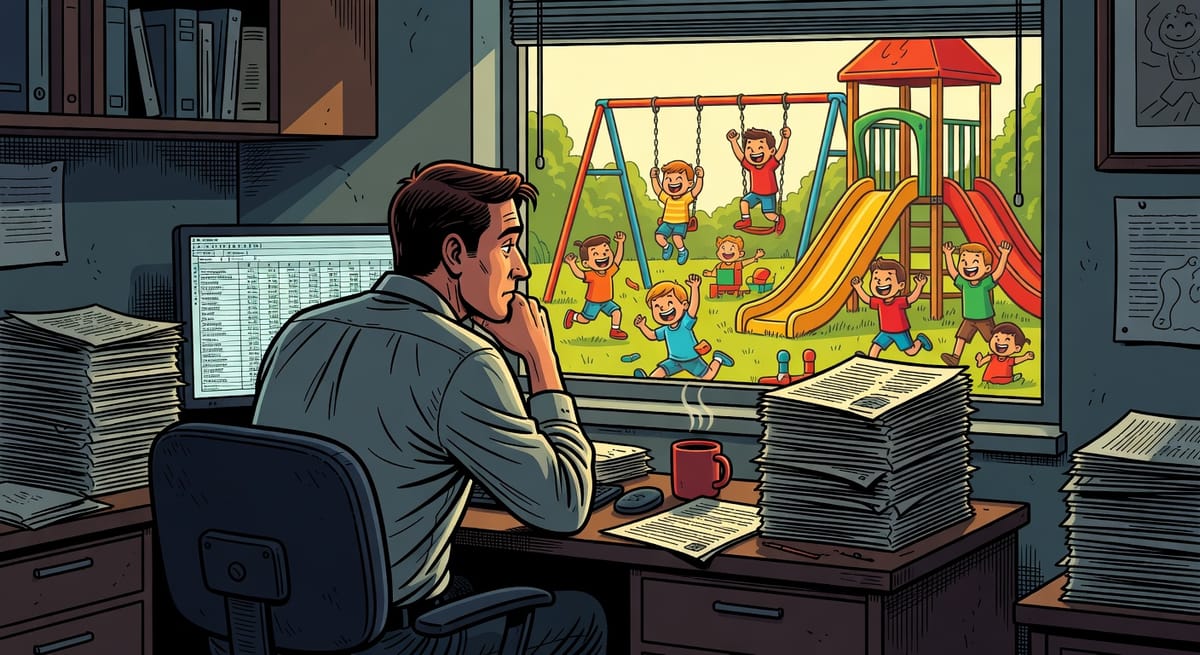
Think back to the last corporate training you sat through. Were you counting the minutes until it was over? Clicking through slides while checking your phone? If you felt disengaged, you're in good company.
Two-thirds of employees worldwide are disengaged at work. That's not a rounding error — it's a global crisis. According to Gallup, disengagement costs the world economy roughly $8.8 trillion every year in lost productivity. Companies are desperate for more innovation, creativity, and adaptability. They keep pouring money into training programs, leadership workshops, and e-learning platforms.
But what if the solution isn't another PowerPoint deck? What if it's something you stopped doing years ago?
What if the answer is PLAY?
It sounds ridiculous. Maybe even unprofessional. But decades of research in neuroscience, psychology, and business strategy all point to the same conclusion: play might be the most powerful learning tool adults have — and we've been ignoring it.
Why We Stopped Playing
As children, we learn almost everything through play. We build worlds out of blocks, stage elaborate imaginary scenes, and figure out complex social rules without cracking a textbook. Play is how we learn to solve problems, work with others, and think creatively.
Then we grow up. And we stop.
We trade exploration for efficiency and curiosity for compliance. We build professional identities based on being serious, competent, and always in control. Play feels risky at work. It requires vulnerability — a willingness to look silly and admit you don't have all the answers. In most offices, that feels like a career-limiting move.
Stuart Brown, who founded the National Institute for Play, has spent over 50 years studying this problem. After interviewing more than 6,000 people about their play histories — including convicted murderers in Texas — he found a consistent pattern. The absence of play is linked to depression, rigidity, reduced creativity, and difficulty adapting to new situations.
Researcher Peter Gray tracked the decline of free play among American children and found something disturbing: as play decreased, rates of anxiety, depression, and narcissism among young people went up. That generation is now in the workforce. And many of them have never learned how to play productively as adults.
What Happens to Your Brain When You Play
For a long time, scientists dismissed play as a way to burn off extra energy. They were wrong.
Neuroscientist Jaak Panksepp discovered that PLAY is one of seven core emotional systems hardwired into the mammalian brain — right next to circuits for fear, anger, and care. Your brain doesn't just enjoy play. It needs play, the same way it needs other core emotional experiences.
Here's what the research shows happens when you play:
Your brain hits the "save button." Play triggers the release of dopamine, the neurochemical that makes you feel good. But dopamine does more than create pleasure — it flags experiences as worth remembering. It strengthens the neural pathways that form long-term memories and sharpens your focus. When you're playing, your brain is literally in a better state for learning.
Your executive function gets a workout. Studies on rats showed that animals deprived of play developed underdeveloped prefrontal cortexes — the brain region responsible for planning, decision-making, and social judgment. Play doesn't just feel good. It builds the part of your brain you use to navigate complex challenges at work.
You enter flow state. Ever been so absorbed in something that you lost track of time? Psychologists call that "flow." Play is one of the most reliable ways to get there. And according to a McKinsey study, executives in flow states are 500% more productive than their baseline. That's not a typo. Five times more productive.
Play isn't a break from learning. It creates the ideal conditions for learning.
The Numbers Don't Lie
If you're still skeptical, here's what the data says.
In 2020, researchers Sailer and Homner published a major meta-analysis of gamification in education. After reviewing dozens of studies, they found significant positive effects across the board: a moderate-to-large effect on cognitive learning (g = 0.49), a meaningful boost to motivation (g = 0.36), and a positive impact on behavioral outcomes (g = 0.25). Translation: play-based methods don't just make people feel better about learning. They actually learn more.
On the corporate side, Deloitte gamified its Leadership Academy and saw a 37% jump in users who came back every week, along with 50% faster course completion. In the e-learning industry more broadly, gamified platforms report 90% completion rates compared to just 25% for traditional alternatives. That's a staggering difference.
And it's not just games. Instructor-led training that uses experiential, play-based methods is roughly 25% faster than self-paced learning — which means play isn't just more engaging, it's more efficient too.
Four Play-Based Methods That Actually Work
This isn't about trust falls or awkward team-building exercises. The best play-based learning methods are structured, purposeful, and backed by real evidence. Here are four that leading companies are using right now.
1. Gamification: Points, Badges, and Better Learning
Gamification means applying game mechanics — like points, badges, leaderboards, and progress bars — to real-world training. It works because it taps into the brain's dopamine-driven reward system, making learning feel more like a challenge to be conquered than a chore to endure.
The key is alignment. Points and badges should reward genuine learning milestones, not just participation. Leaderboards need to be handled carefully — they motivate top performers but can discourage everyone else. Progress bars and "level-up" systems create a compelling sense of forward movement.
Try this: Take your next team training goal and frame it as a mission. Create a simple tracker where people can see their progress. Even a shared spreadsheet with milestones can tap into the same psychology that makes games addictive.
2. LEGO Serious Play: Build Your Ideas (Literally)
LEGO Serious Play is a facilitated method where people use LEGO bricks to build three-dimensional models of their ideas. It sounds like kindergarten, but it's used by Fortune 500 companies for strategy, team alignment, and solving messy problems.
Why does it work? When you build something with your hands, you engage your brain differently than when you just talk. Scientists call this "embodied cognition" — your physical actions actually shape your thinking. The act of building makes abstract ideas concrete and helps teams have more honest conversations about things that are hard to put into words.
A 2004 study by Roos and colleagues found that LEGO Serious Play improved strategic planning by helping participants surface hidden assumptions and explore complex systems through physical metaphor. In 2024, a study published in Nature confirmed that the method enhances teamwork, reduces free-riding in groups, and helps people understand others' perspectives.
Try this: In your next brainstorm, skip the whiteboard. Ask everyone to sketch or build their ideas instead. Making thought visible and physical unlocks a different kind of thinking.
3. Design Thinking: Innovate Like a Startup
Design thinking is the problem-solving method behind companies like Google, Airbnb, and Apple. It follows five stages: Empathize, Define, Ideate, Prototype, and Test. And it's deeply playful.
The "Crazy 8s" technique asks you to sketch eight ideas in eight minutes — no time for your inner critic. "How Might We" reframes every challenge as a question full of possibility. And rapid prototyping — building rough models from paper, foam, or cardboard — lets teams test ideas without fear of failure.
Google Ventures compressed the whole process into a five-day Design Sprint. The approach has helped hundreds of companies, from startups to LEGO itself, move faster and think bigger.
Try this: Next time your team faces a challenge, reframe it as a "How Might We" question. Instead of "We need to reduce customer complaints," try "How might we create a support experience that customers actually enjoy?" This simple language shift opens up creative space.
4. Improv: The Power of "Yes, And"
The core principle of improv comedy is "Yes, and..." — you accept what your partner offers and build on it. It's the exact opposite of how most meetings work, where ideas get shot down with "No, but..." or "We tried that before."
Companies like Google and PepsiCo have used improv training to build active listening skills, boost creativity, and help teams adapt faster. The corporate training arm of Chicago's famous Second City troupe has worked with countless Fortune 500 companies. Researchers Vera and Crossan demonstrated in 2004 that improvisational skills are a critical organizational capability — the ability to respond creatively to the unexpected.
Try this: In your next meeting, practice "Yes, and..." for just 10 minutes. No shutting down ideas, no "but." Only building. See what emerges when people stop blocking and start collaborating.
How to Get Started (Without a Big Budget)
You don't need executive buy-in or a consultant to begin. Here are three things you can do this week:
Create psychological safety first. Play requires vulnerability. People won't take creative risks if they're afraid of looking foolish. Amy Edmondson's research at Harvard shows that psychological safety — the belief that you won't be punished for speaking up — is the single biggest predictor of effective teams. Model the behavior yourself: admit when you don't know something, celebrate smart failures, and make it okay to experiment.
Try Liberating Structures. This is a free collection of 33 simple formats for organizing group work, created by Henri Lipmanowicz and Keith McCandless. One example: "1-2-4-All" — start by thinking alone for one minute, then share with a partner, then a group of four, then the whole room. It takes any boring meeting and makes it participatory and energizing. Zero cost, zero training required.
Start small and measure. Pick one meeting a week. Add one playful element — a "How Might We" question, a quick "Yes, and..." warm-up, or a build-it-before-you-say-it brainstorm. Track what changes. More ideas? Better energy? Faster decisions? The evidence will build itself.
The Bottom Line
Play is not the opposite of serious work. It's the engine of it.
It makes us more creative, more engaged, and better at learning new things. In a world that demands constant adaptation, the willingness to play — to experiment, to be vulnerable, to try things that might not work — is a genuine competitive advantage.
The neuroscience is clear. The data is compelling. The methods are proven. The only question left is whether you're willing to try.
So here's the challenge: what is one small way you can bring play into your work this week?
Your brain is ready. It's been waiting for recess.