Is Gen Z Really Less Intelligent? The Science Behind the IQ Decline Debate
A balanced examination of the reverse Flynn Effect, its critics, and what the data actually shows
The Headline That Launched a Thousand Hot Takes
In January 2026, Dr. Jared Cooney Horvath testified before the U.S. Senate Commerce Committee about technology’s impact on young minds. Within hours, headlines screamed: “Gen Z is dumber than their parents.” But what does the science actually say? The answer, as with most things in intelligence research, is far more nuanced than any headline can capture.
For over a century, humanity enjoyed a remarkable trend: each generation scored higher on IQ tests than the last, gaining roughly 3 points per decade. This phenomenon, named the Flynn Effect after the New Zealand researcher James Flynn who documented it in 1984, seemed like an unstoppable escalation of human cognitive ability. Then, sometime in the mid-1990s, the escalator appeared to reverse – at least in some countries.
Welcome to one of the most contentious debates in modern psychology.
The Case for Decline: When the Numbers Started Falling
The most compelling evidence for declining IQ comes from Scandinavian military conscription data, which offers something rare in social science: large, mandatory, population-level samples tested with consistent instruments over decades.
Bratsberg and Rogeberg’s 2018 landmark study in the Proceedings of the National Academy of Sciences analyzed over 730,000 Norwegian male conscripts born between 1962 and 1991. They found that IQ scores peaked for the 1975 birth cohort, then declined at roughly 0.3 points per year. What made this study especially powerful was its within-family design: by comparing brothers tested at different times, the researchers ruled out genetic or immigration-based explanations. The decline was environmental, not hereditary (Bratsberg & Rogeberg, 2018).
Norway was not alone. Teasdale and Owen (2005) documented a similar reversal in Denmark, analyzing 500,000 conscripts tested between 1959 and 2004. Scores peaked around the 1980 birth cohort, then dropped 1.5 points in just five years. In Finland, Dutton and Lynn (2013) found declines averaging 2.0 IQ points per decade from 1997 to 2009, reversing gains of 4.0 points per decade in the previous nine years.
The debate crossed the Atlantic in 2023 when Dworak, Revelle, and Condon published their analysis of 394,378 American adults from Northwestern University’s SAPA Project. Testing participants from 2006 to 2018, they found declines in verbal reasoning, matrix reasoning, and letter-number series across virtually every demographic group. The steepest drops appeared among 18-to-22-year-olds – squarely within Gen Z (Dworak et al., 2023).
Perhaps most alarming was Flynn and Shayer’s own 2018 analysis, which found that IQ losses in Nordic nations projected to 6.85 points over 30 years. Using Piagetian cognitive development tests, they identified a particularly troubling pattern: the “decimation at the top” – fewer people reaching the formal operations stage of abstract and deductive reasoning. As they put it, “the rot starts at the top” (Flynn & Shayer, 2018).
A systematic review by Dutton, van der Linden, and Lynn (2016) applied strict quality criteria and identified negative Flynn Effects in at least seven countries: Norway, Denmark, Finland, the UK, France, the Netherlands, and Australia. The declines generally began in the mid-1990s.
Proposed Mechanisms: What Could Be Causing It?
Researchers have proposed several environmental drivers for the decline:
- Screen time and digital media: Meta-analyses link heavy screen use to compromised attention and executive function. Six or more hours of daily screen time has been associated with measurable changes in grey and white matter volume.
- Reduced deep reading: Verbal reasoning shows the steepest declines, coinciding with a dramatic drop in leisure reading among young adults.
- Educational shifts: Movement from abstract reasoning and formal logic toward visual and digital learning formats.
- Attention fragmentation: The constant-switching digital environment may be eroding sustained concentration – the kind needed for complex reasoning tasks.
The Counter-Evidence: Why the Decline May Be an Illusion
Not everyone is convinced the sky is falling. A formidable body of research challenges the decline narrative on multiple fronts.
The Meta-Analyses Tell a Different Story
The largest meta-analysis on the subject, by Trahan, Stuebing, Fletcher, and Hiscock (2014) in Psychological Bulletin, examined 285 studies covering 14,031 participants and found IQ gains of 2.93 points per decade on standardized tests since 1972, with no evidence the Flynn Effect was diminishing.
Pietschnig and Voracek (2015) conducted an even broader analysis: 271 independent samples, nearly 4 million participants, across 31 countries over a full century. Their conclusion: global IQ gains continue, though at diminishing rates. Fluid intelligence – the capacity for novel reasoning – was still gaining 0.41 points per year (Pietschnig & Voracek, 2015).
The Measurement Problem
Here is where the critique becomes devastating. Wicherts, Dolan, and Hessen (2004) demonstrated something fundamental: IQ tests are not measurement invariant over time. Individual items change in difficulty as culture shifts. The word “terminate” became easier to define after the Terminator films; knowledge of the “Kremlin” shifted after the Gremlins franchise confused a generation. What looks like cognitive decline may simply be vocabulary drift.
Gonthier, Gregoire, and Besancon (2021) put this to the test directly. They reanalyzed the French data that Dutton and Lynn (2015) had used to claim France was getting dumber. Their finding was striking: the apparent decline was entirely attributable to culture-dependent knowledge items becoming outdated. The correlation between a subtest’s cultural load and its apparent decline was 0.95. When culture-fair measures were used, no decline existed at all (Gonthier et al., 2021).
Most recently, Nordmo, Norronne, and Lang-Ree (2025) reanalyzed the very same Norwegian military data that anchors the decline narrative. Using multiple-group factor analysis and MIMIC models, they concluded that neither the historical rise nor the recent decline reflects changes in latent general mental ability. The apparent fluctuations were driven by specific subtests – figure matrices going up, word comprehension going down – not by a shift in underlying intelligence.
The Global Picture
The reverse Flynn Effect is geographically limited. IQ continues to rise in developing and transitional economies. Must, Must, and Raudik (2003) documented nearly a full standard deviation of gain in Estonia. Daley et al. (2003) found robust gains among rural Kenyan children. The Flynn Effect is alive and well in most of the world – the reversal is confined to wealthy, post-industrial nations (Must et al., 2003; Daley et al., 2003).
An expert survey by Rindermann, Becker, and Coyle (2017) found that intelligence researchers expect continued gains of roughly 6 IQ points in lower-ability regions through the 21st century, with only a slight decline of 0.45 points in the U.S. and 3 points in Western Europe by 2100. The consensus is plateauing, not collapse.
The Third Way: Cognitive Specialization
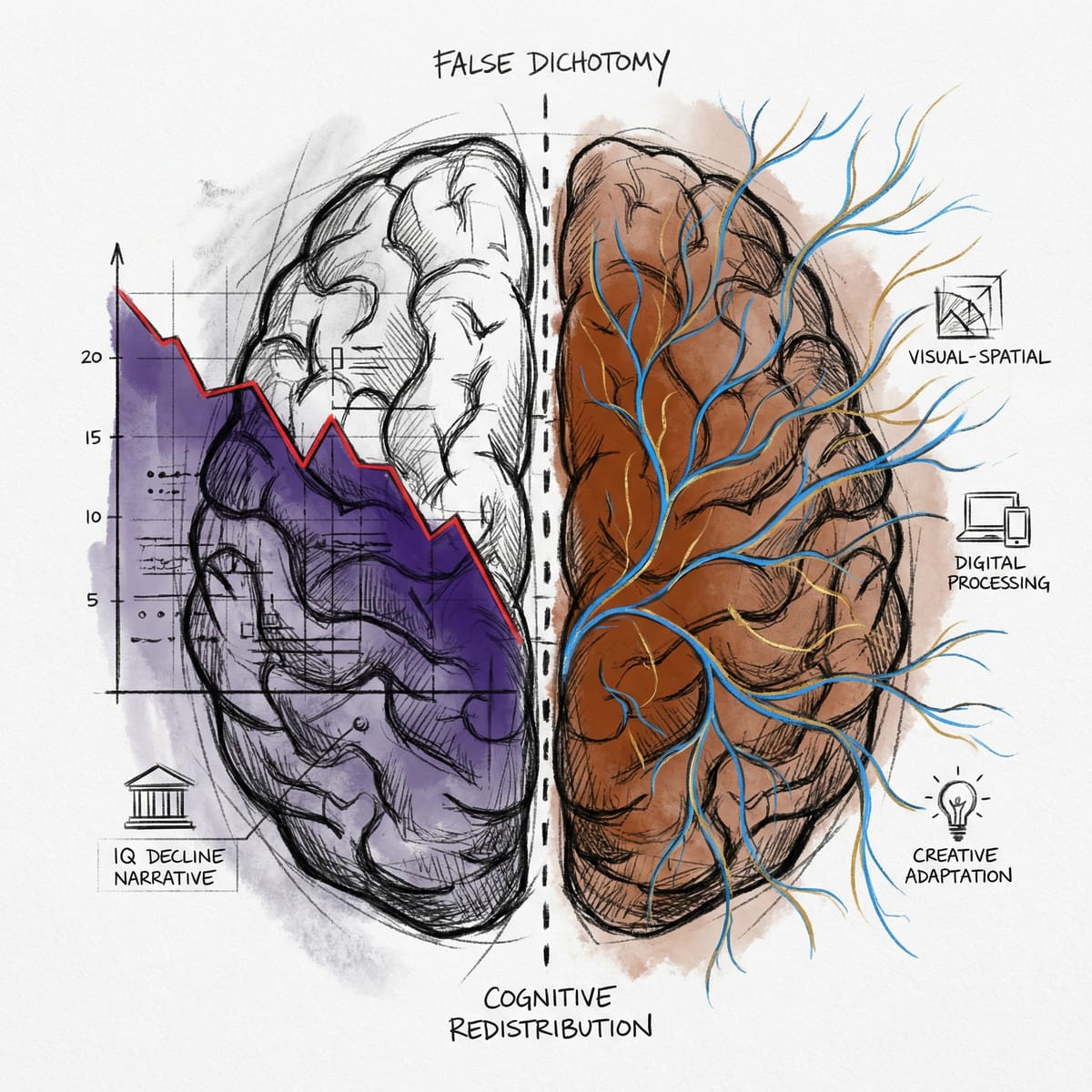
The most intellectually satisfying resolution may come from neither the decline camp nor the “nothing to see here” camp, but from a third perspective: cognitive specialization.
Andrzejewski, Zeilinger, and Pietschnig (2024), publishing in the Journal of Intelligence, analyzed 1,392 Austrian residents across three standardization waves from 2005 to 2018. Their findings were paradoxical: IQ scores increased across all measured domains, yet the general intelligence factor (g) declined. How is this possible?
Their explanation uses a decathlon analogy. An athlete who specializes in the high jump may see their overall decathlon score drop even as their high jump performance soars. They haven’t become a worse athlete – they’ve specialized. Similarly, people may be developing stronger but more differentiated cognitive profiles, excelling in specific domains while the correlations between abilities weaken (Andrzejewski et al., 2024).
Oberleiter et al. (2024) extended this analysis to 2024 and confirmed the trend: the “positive manifold” – the tendency for cognitive abilities to correlate with each other – is declining. People are becoming cognitive specialists rather than cognitive generalists.
This interpretation gains support from an overlooked detail in the Dworak et al. (2023) American study: while three cognitive domains declined, 3D spatial rotation scores actually increased. If general intelligence were truly declining, all domains should fall together. The inconsistency supports redistribution over decline.
Gen Z demonstrably excels in visual information processing, digital navigation, rapid filtering of information streams, and adaptive multitasking – cognitive skills that traditional IQ batteries simply do not measure. As Flynn himself argued across multiple works, cognitive abilities are multifaceted and environmentally responsive: “The 20th century has seen some cognitive skills make great gains, while others have been in the doldrums.”
What Dr. Horvath Actually Said
The 2026 media explosion deserves its own correction. Dr. Horvath’s Senate testimony focused on educational technology’s negative impact on academic performance, citing PISA, TIMSS, and PIRLS international assessments and meta-analyses of EdTech effectiveness. He was not making claims about IQ decline per se. The media conflated standardized academic test scores with intelligence – a conflation that would make most psychometricians wince.
So, Is Gen Z Less Intelligent?
The honest answer: it depends entirely on what you mean by “intelligent.”
If you mean “scores on traditional IQ tests measuring verbal reasoning, general knowledge, and computational skills” – then yes, there is evidence of modest declines in several developed nations, roughly 0.3 points per year since the mid-1990s. The Norwegian within-family data makes this hard to dismiss entirely.
If you mean “underlying general mental ability” – the evidence is far less clear. The measurement invariance critique is powerful: tests designed for mid-20th-century cognitive ecologies may be losing validity. When you control for cultural item drift, much of the decline evaporates.
If you mean “overall cognitive capability” – then the specialization hypothesis offers the most balanced framework. Gen Z’s cognitive resources may be distributed differently, not diminished. Gains in visual-spatial reasoning and digital processing may come at the cost of verbal fluency and sustained abstract thought. The total cognitive budget may be roughly stable; its allocation has shifted.
What we can say with confidence is this: the story is not “Gen Z is dumb.” It is that the cognitive landscape is changing, shaped by digital environments, shifting educational priorities, and new demands on attention. Whether this represents decline, adaptation, or redistribution remains one of the most important open questions in psychological science.
References
Andrzejewski, C., Zeilinger, E. L., & Pietschnig, J. (2024). Positive manifold decline and the Flynn Effect in Austria: A multi-wave analysis. Journal of Intelligence, 12(3). https://doi.org/10.3390/jintelligence12030055
Bratsberg, B., & Rogeberg, O. (2018). Flynn effect and its reversal are both environmentally caused. Proceedings of the National Academy of Sciences, 115(26), 6674-6678. https://doi.org/10.1073/pnas.1718793115
Daley, T. C., Whaley, S. E., Sigman, M. D., Espinosa, M. P., & Neumann, C. (2003). IQ on the rise: The Flynn Effect in rural Kenyan children. Psychological Science, 14(3), 215-219.
Dworak, E. M., Revelle, W., & Condon, D. M. (2023). Looking for Flynn effects in a recent online U.S. sample. Intelligence, 98, 101734. https://doi.org/10.1016/j.intell.2023.101734
Dutton, E., & Lynn, R. (2013). A negative Flynn Effect in Finland, 1997-2009. Intelligence, 41(6), 817-820. https://doi.org/10.1016/j.intell.2013.05.008
Dutton, E., van der Linden, D., & Lynn, R. (2016). The negative Flynn Effect: A systematic literature review. Intelligence, 59, 163-169. https://doi.org/10.1016/j.intell.2016.10.002
Flynn, J. R., & Shayer, M. (2018). IQ decline and Piaget: Does the rot start at the top? Intelligence, 66, 112-121. https://doi.org/10.1016/j.intell.2017.11.010
Gonthier, C., Gregoire, J., & Besancon, M. (2021). No negative Flynn Effect in France: Why variations in IQ are not an index of changes in abilities. Intelligence, 84, 101510. https://doi.org/10.1016/j.intell.2020.101510
Must, O., Must, A., & Raudik, V. (2003). The secular rise in IQs: In Estonia, the Flynn Effect is not a Jensen Effect. Intelligence, 31(5), 461-471.
Nordmo, M., Norronne, L. K., & Lang-Ree, O. C. (2025). Re-examining the Flynn Effect in Norwegian conscript data: A measurement invariance approach. Intelligence, 108. https://doi.org/10.1016/j.intell.2024.101877
Oberleiter, S., et al. (2024). Extended positive manifold analysis in Austrian cognitive assessment data. Intelligence, 107.
Pietschnig, J., & Voracek, M. (2015). One century of global IQ gains: A formal meta-analysis of the Flynn Effect (1909-2013). Perspectives on Psychological Science, 10(3), 282-306. https://doi.org/10.1177/1745691615577701
Rindermann, H., Becker, D., & Coyle, T. R. (2017). Survey of expert opinion on intelligence. Personality and Individual Differences, 107, 1-13. https://doi.org/10.1016/j.paid.2016.11.009
Teasdale, T. W., & Owen, D. R. (2005). A long-term rise and recent decline in intelligence test performance. Personality and Individual Differences, 39(4), 837-843.
Trahan, L. H., Stuebing, K. K., Fletcher, J. M., & Hiscock, M. (2014). The Flynn Effect: A meta-analysis. Psychological Bulletin, 140(5), 1332-1360. https://doi.org/10.1037/a0037173
Wicherts, J. M., Dolan, C. V., Hessen, D. J., et al. (2004). Are intelligence tests measurement invariant over time? Intelligence, 32(5), 509-537.