Don’t Put All Your Eggs in One Basket: A Beginner’s Guide to Investing Wisely
New to investing? Learn why spreading your money across different sectors protects you — and why your age changes everything about your strategy.
Published March 4,2026 | Educational use only | Not financial advice
You've probably heard the phrase a thousand times: don't put all your eggs in one basket. It sounds like something your grandma would say. But when it comes to investing, it might be the most important piece of advice you ever get.
So, What Is Diversification?
Diversification just means spreading your money across different types of investments so that you're not betting everything on one thing.
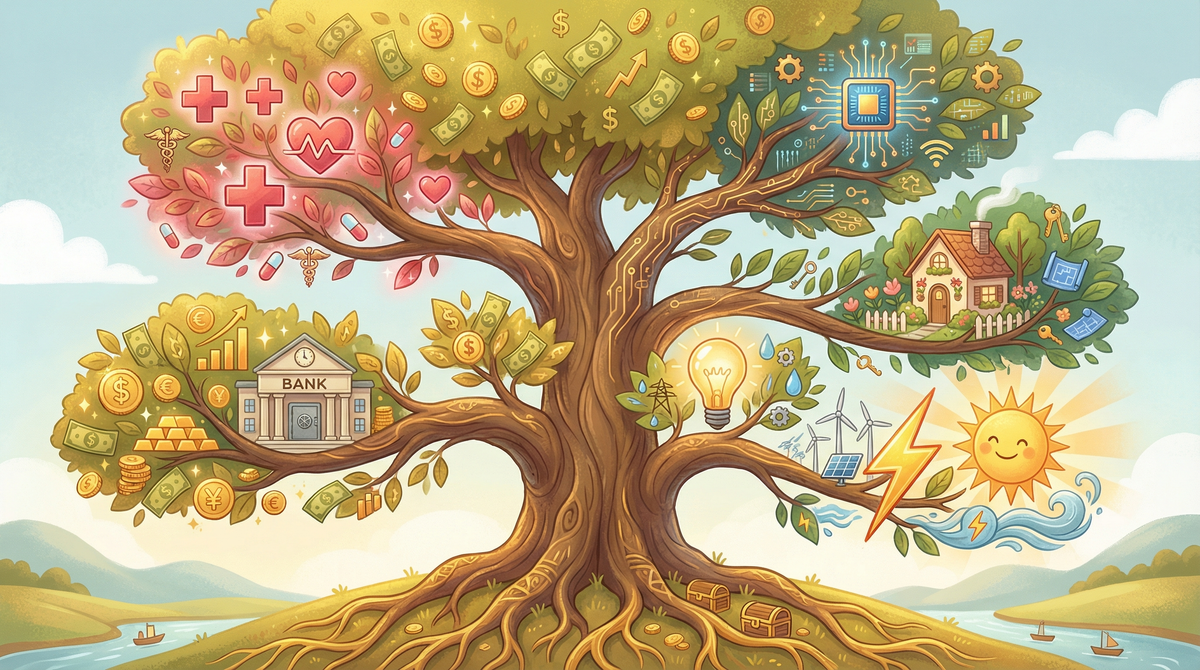
In the stock market, you're spreading money across different sectors — like healthcare, technology, real estate, energy, and financial companies. You're also spreading across different types of investments — like stocks, bonds, and funds.
Why Does It Matter? Let's Look at What Can Go Wrong
In 2020, travel and hospitality stocks crashed when COVID-19 hit. Airlines, hotels, cruise lines — all of them took massive losses. If your entire portfolio was in travel stocks, you lost a significant chunk of your savings in a matter of weeks.
But investors who had their money spread out? They still took some hits, sure. But healthcare stocks were surging. Technology companies were booming as everyone worked from home. The losses in one area were offset by gains in another.
That's the whole point. Diversification doesn't guarantee you'll make money. But it protects you from being completely wiped out when one sector has a bad year.
Before You Invest: Start With Retirement Accounts
Before you open a regular brokerage account, there's a smarter place to put your money first — tax-advantaged retirement accounts.
- 401(k): If your employer offers one, contribute at least enough to get the full employer match. That match is essentially free money — don't leave it on the table.
- Roth IRA: A personal retirement account where you invest after-tax dollars, and your money grows completely tax-free. This is especially powerful for younger investors who have decades of growth ahead.
- Traditional IRA: Similar to a Roth IRA, but you get a tax deduction now, and you pay taxes when you withdraw in retirement.
These accounts don't change what you invest in — you can still buy ETFs and diversified funds inside them. But they help you keep more of your gains instead of handing them to the IRS. Start here before moving to a regular brokerage account.
How Much Should You Invest?
One of the biggest barriers for new investors is thinking they need a large sum of money to start. They don't.
A good rule of thumb based on your financial situation:
- If you have high-interest debt (credit cards): Pay that off first. A credit card charging 20% interest is guaranteed to cost you more than any investment can reliably earn. Once it's paid off, redirect that payment toward investing.
- If you're debt-free or only have low-interest debt: Aim to invest 10–15% of your gross income. This is a widely recommended baseline for long-term wealth building.
- If you can push further: Some financial advisors suggest 20% or more for people who started late or want to build wealth faster.
- If 10% feels impossible right now: Start with 1–5%. Automate it. Increase it by 1% each year as your income grows. Consistency matters far more than the amount when you're starting out.
The single worst strategy is waiting until you "have enough" to invest. Time in the market is the most valuable asset you have.
Where to Open an Account
If you're starting from zero, you'll need a brokerage account. For beginners, these platforms are well-regarded for being user-friendly, low-cost, and trustworthy:
- Fidelity — No account minimums, great research tools, strong customer service
- Vanguard — Founded by the inventor of the index fund; known for low fees and a long-term investing philosophy
- Charles Schwab — No minimums, solid educational resources, beginner-friendly interface
- Robinhood — Simple mobile-first experience; good for getting started, though fewer advanced tools
For retirement accounts, Fidelity and Vanguard are the most popular choices among long-term investors due to their low fees.
The Biggest Factor Most Beginners Overlook: Your Age
Here's the part that most beginner investment guides gloss over: the right strategy for a 20-year-old is very different from the right strategy for someone who's 45. And the reason comes down to one word — time.
If You're Around 20 Years Old
You have the most powerful asset in investing: time.
Let's say you invest $5,000 today at age 20 and it grows at an average of 8% per year (roughly what the S&P 500 has averaged historically). By the time you're 60, that single $5,000 would be worth over $108,000 — without you adding another dollar.
That's the magic of compound interest. Your money makes money, then that money makes money, and it snowballs over decades.
Because you have 40+ years before you'll need most of your money, you can afford to take more risk. If the market drops 30% in a recession, you have time to wait for it to recover — and it historically always has.
What this means for a 20-year-old investor:
- Put most of your money (70–90%) in growth-focused investments like stock index funds
- A smaller portion in bonds or stable assets (10–30%) to smooth out the bumps
- You can explore higher-risk, higher-reward options like small-cap stocks or emerging markets
- The most important thing? Start now, even if it's small
If you start investing at 20, you're not just investing money. You're investing time — and time is the one thing you can never buy more of.
If You're in Your 30s
Your 30s are a transition decade. You probably have more income than you did at 22, more financial responsibilities (mortgage, kids, student loans), and roughly 25–35 years before retirement.
This is the decade to build aggressively while starting to think about balance.
You still have time on your side — your portfolio can recover from downturns. But you're also getting closer to the window where losing ground starts to hurt more.
What this means for a 30-something investor:
- Keep a growth-heavy allocation — around 70–80% in stocks, 20–30% in bonds or more stable assets
- If you haven't maxed out your Roth IRA or 401(k) yet, make that the priority
- This is a great time to add more diversity — international funds, dividend-paying stocks, and real estate (REITs) can start playing a bigger role
- Revisit your allocation every few years, not just once
Think of your 30s as locking in the habits that will define your financial picture by 50.
If You're 40 or 50 Years Old
This isn't meant to stress you out — but if you're starting now, there's a different reality to work with.
You likely have 10–25 years before retirement. That's still a solid runway. But there's less time to recover from big losses, so the strategy shifts from chasing growth to balancing growth with protection.
Think of it this way: a 25-year-old investor can ride out a major market crash and patiently wait years for recovery. A 50-year-old who plans to retire in 15 years can't afford to watch their savings cut in half right before they need it.
What this means for a 40–50-year-old investor:
- A more balanced split — maybe 50–70% in stocks and 30–50% in bonds or stable assets
- Focus on sectors that pay regular income (called dividends) — like utilities, real estate investment trusts (REITs), and healthcare
- Less exposure to volatile, high-risk investments
- Prioritize consistency over big gains
This doesn't mean playing it so safe that your money doesn't grow. Inflation is real — if your money earns less than inflation, you're technically losing purchasing power. You still need growth. Just with more guardrails.
Age-Based Strategy at a Glance
| 20s | 30s | 40s–50s | |
|---|---|---|---|
| Time to retirement | 40+ years | 25–35 years | 10–25 years |
| Risk tolerance | High | Moderate-High | Moderate |
| Stock allocation | 70–90% | 70–80% | 50–70% |
| Bonds/stable assets | 10–30% | 20–30% | 30–50% |
| Top priority | Start early, grow fast | Build habits, diversify | Protect gains, generate income |
Where Do You Start? Five Simple Steps
Whether you're 22 or 52, here's how to begin building a diversified portfolio without needing a finance degree:
1. Start with index funds or ETFs.
An ETF (Exchange-Traded Fund) is a single investment that holds dozens or hundreds of stocks at once. An S&P 500 ETF, for example, gives you exposure to 500 of the biggest U.S. companies in one purchase. Instant diversification.
2. Don't pile everything into one hot sector.
Tech stocks have had an incredible run. But past performance doesn't guarantee future results. Spread your bets across multiple sectors — healthcare, utilities, financials, real estate, and international markets all deserve a look.
3. Invest consistently, not all at once.
Instead of dropping everything in on one day, invest a set amount every month (this is called dollar-cost averaging). This way, you buy more shares when prices are low and fewer when they're high — automatically.
4. Don't panic when the market dips.
Every major market crash in history has been followed by a recovery. Selling when prices are down locks in your losses. The investors who stayed calm and held through 2008, 2020, and every correction in between came out ahead.
5. Revisit your portfolio every year.
Your life changes. Your strategy should too. What's right at 25 might not be right at 35 or 55. An annual check-in keeps things aligned.
The Bottom Line
Remember that $5,000 invested at age 20? By 60, it becomes $108,000 — without adding another dollar.
Now imagine investing consistently over 30 or 40 years. Diversified. Patient. Automated. That's not luck — that's the math of compound interest working for you.
Investing can feel complicated, but the core principle is simple: spread your money, stay consistent, and let time do the heavy lifting.
🟢 Sectors Worth Exploring in 2026
1. Healthcare
Think about it: people always need doctors, medicine, and hospitals — no matter what the economy does. That alone makes healthcare one of the most stable sectors out there.
What makes it even more interesting right now? Healthcare companies are starting to use artificial intelligence to cut costs and speed up research. It's becoming more efficient. And according to market analysts, healthcare stocks are currently priced about 20% cheaper than the average stock market — which means you might be buying in at a discount before prices catch up.
For someone with a moderate risk tolerance, healthcare is worth a serious look.
Simple example: Think of it like buying a popular brand of sneakers on sale. The shoes are just as good — they're just temporarily marked down.
What to look into: Healthcare ETFs (funds that pool together many healthcare companies), health insurance companies, pharmaceutical stocks.
2. Defense & Aerospace
This one might surprise you, but defense is booming right now.
The US government has set a record defense budget of over $900 billion for 2026. That money is going toward things like drones, high-tech weapons systems, space programs, and AI-powered military tech.
When the government spends that kind of money, it goes to companies — and those companies make money, which flows to shareholders (that's you, if you own their stock).
International tensions around the world have also pushed other countries to increase their defense budgets. This isn't going away anytime soon.
Simple example: Imagine the government is building a massive highway. The companies selling cement, steel, and construction equipment are going to do really well. Defense works the same way.
What to look into: Defense ETFs, companies like Northrop Grumman, Raytheon, L3Harris.
3. Real Estate (REITs)
Real estate investment trusts — or REITs (pronounced "reets") — are basically a way to invest in real estate without buying an actual house or building.
REITs are companies that own properties and are required by law to share at least 90% of their taxable income with shareholders. That means if you own REIT shares, you get regular income payments called dividends. Think of it like being a landlord, but without having to fix anyone's leaky faucet.
What's extra exciting right now: data center REITs are on fire. As AI keeps growing, companies need massive warehouses full of computers to run it all. Companies like Equinix and Digital Realty own those buildings and are seeing huge demand.
Simple example: You own a storage unit business. People keep needing to store more stuff (in this case, data). Business is booming.
What to look into: Data center REITs, healthcare REITs, residential REITs.
4. Financials (Banks & Financial Companies)
Banks, insurance companies, and investment firms make up the financial sector. This one is often underrated by beginner investors.
In 2026, financials are considered undervalued by many market analysts — meaning analysts think these stocks are worth more than their current price. That's an opportunity for someone with your timeline (3–10 years) to get in before the market adjusts.
When interest rates are in a reasonable range (which they are heading into 2026), banks tend to do well because they profit from the difference between what they charge for loans and what they pay for deposits.
Simple example: The bank charges 7% for your car loan but pays you 2% on your savings account. That 5% gap is how they make money. Multiply that by millions of customers.
What to look into: Financial ETFs, big banks (JPMorgan, Bank of America), insurance companies.
5. Utilities
Boring? Maybe. But boring in investing is often a good thing.
Utilities companies provide electricity, water, and gas. People pay their utility bills even during recessions. These companies don't grow super fast, but they're incredibly stable and usually pay solid dividends (regular income payments).
Here's a 2026 twist: utility companies are also in high demand because powering AI data centers requires enormous amounts of electricity. AI infrastructure is using more power than ever, and utilities are quietly becoming an unexpected winner.
Simple example: Utilities are like the landlord of essential services. People can cut back on lattes during hard times. They can't cut their electricity.
What to look into: Utility ETFs, companies focused on grid modernization and power generation.
6. Consumer Staples
These are companies that sell things people need every day, no matter what — think food, household cleaners, toothpaste, and toilet paper.
Procter & Gamble, Coca-Cola, Walmart — these are consumer staple companies. They don't make you rich overnight, but they hold steady when everything else is dropping.
Simple example: Even during the 2008 financial crisis, people still bought soap. Consumer staple companies barely flinched.
What to look into: Consumer staples ETFs, large household brand companies.
7. International Markets (Outside the US)
Right now, a huge chunk of the US market's gains over the past few years came from just a small group of giant tech companies. That's not great for long-term stability.
Adding some international exposure — companies from Europe, Japan, or emerging markets like India and Southeast Asia — can balance that out. If US stocks dip, international stocks sometimes move in a different direction.
Simple example: Don't just root for one team. Invest in multiple leagues. If one league has a bad season, the others can carry you.
What to look into: International ETFs, emerging market ETFs, developed market funds (Europe, Japan).
8. Small-Cap Stocks (Smaller Companies)
Large companies like Apple and Microsoft get all the attention. But smaller companies — "small-caps" — have been underperforming big companies for years, which means they might be due for a comeback.
Small-cap stocks are riskier, but with a 3–10 year horizon, you have enough time to ride out the ups and downs. The potential upside can be significant.
Simple example: Small caps are like betting on a local restaurant before it becomes a national chain. Higher risk, but if it works out — big reward.
What to look into: Small-cap value ETFs (funds that focus on smaller, undervalued companies).
🔴 Sectors to Be Careful With (Or Avoid for Now)
❌ Overvalued Tech & AI Stocks
Tech and AI stocks have gone on a huge run. Many of them are now priced at levels that only make sense if they keep growing at an insane pace. If growth slows down even a little — boom, prices drop fast.
This doesn't mean sell all your tech. It means be cautious about adding more at current prices, and definitely don't put even more of your portfolio into it. You already have that exposure.
❌ Consumer Discretionary (Luxury & Optional Purchases)
This sector covers things people want but don't need — like luxury goods, certain retail brands, entertainment, etc.
The problem: just two companies (we're looking at you, Amazon and Tesla) make up nearly half of this entire sector. That's a lot of concentration risk — if those two stumble, the whole sector suffers. And with consumers tightening their wallets amid economic uncertainty, spending on "nice to have" items tends to drop first.
Tesla alone is currently valued at nearly 200 times its expected earnings — which is extremely high by any measure.
❌ Industrial Stocks Tied to AI Data Centers
Some industrial companies rode the wave of data center construction and have done incredibly well. But because they've done so well, their prices are now very high.
If data center growth slows down — or if the AI hype cools at all — these overpriced industrials could take a significant hit. Until valuations come down, it's a risky place to put fresh money.
🗺️ Putting It All Together: A Sample Portfolio Idea
Here's a rough picture of how someone with your profile might think about spreading things out. This isn't financial advice — it's just an illustration:
| Sector | Why |
|---|---|
| S&P 500 Index Fund | Keep it as your core |
| Healthcare | Undervalued, stable, AI-enhanced |
| Defense | Record spending, strong demand |
| REITs (Data Center/Residential) | Passive income + growth |
| Financials | Undervalued, steady |
| Utilities | Stable, income-producing |
| Consumer Staples | Defensive anchor |
| International ETFs | Balance US concentration |
| Small-Cap Value | Growth potential over 3-10 years |
A Few Final Tips for the Beginner Investor
-
ETFs are your friend. An ETF (Exchange-Traded Fund) lets you buy a tiny piece of many companies at once. Instead of picking one healthcare company and hoping it does well, you buy a healthcare ETF and own a slice of dozens of them. Much safer.
-
Don't try to time the market. Nobody — not even the pros — consistently knows when to buy and sell at the perfect moment. Invest regularly (monthly or quarterly) and let time do the work.
-
Don't panic when prices drop. With a 3–10 year window, short-term dips are normal. The market has always recovered over time. Selling during a dip is the #1 mistake new investors make.
-
Talk to a financial advisor. This report is a starting point, not a final answer. A certified financial planner (CFP) can look at your full financial picture and help you build a plan that's right for you.
Sources & Further Reading
- Morningstar: How to Diversify Your Portfolio in 2026
- iShares: 2026 Market Outlook
- Charles Schwab: Monthly Stock Sector Outlook 2026
- Simply Wall St: Three Sectors Expected to Rally in 2026
- Yahoo Finance: Top 3 Investment Themes for 2026
- BlackRock: AI Stocks and the New Market Playbook for 2026
- Morgan Stanley: Investment Outlook 2026
- Fidelity: 2026 Sector Investing Ideas